Tuesday, September 4, 2018

Dystonia Awareness Month

As September is Dystonia awareness month, I’ve been sitting back and thinking about the past 3 years; all I can say is holy s*** this has been an adventure. There have been many obstacles I’ve faced, and have beaten the odds more than anyone imagined. Being told numerous of times that I wouldn’t be able to walk again was the fuel to my fire to proof everyone wrong that I will be able to walk again. More importantly, I proved to myself that if you want something badly, you will do whatever it takes to make a dream come true. My dream came true; I am walking on my own. 
This has been one of the hardest journey's I’ve encountered, and I refuse to give up. My motto has always been, "losing is not an option". The jigsaw puzzle is being pieced together, and there is a clearer overview for why my legs became deformed and spastic. I didn’t want to give up finding the root cause, as my gut was screaming something wasn’t right; I knew there was more to the story, and soon the next chapter will begin. This chapter will be focusing on my spinal cord, and how there is a strong believe this is causing the Dystonia.
Fighting to be your own advocate is easier said than done, and I will admit it isn't easy. Throughout my journey living with Dystonia, I have learned how to be my own case manager, and speak up for what I need. It was hard in the beginning, and within time, it became easier. It can be hard to speak up for your personal needs, and it is okay to ask for assistance. Let's be honest, humans in general don't know everything. One of the ways we learn is by asking others who may have expertise about the topic; if they don't know the answer, there is a possibility that individual can steer you in the right direction. There are many forms of support systems; family, friends, and colleagues, are just some of the examples of support systems you can rely on. When times become difficult, use your support team; these individuals will help you navigate the resources you need to be your own best advocate. There was some wise words I have learned, and anyone can implement it in their lives; you are your own best advocate.


Monday, June 11, 2018

My legs 3 years later

For the past few weeks, I‘be been working on a painting reflecting the last three years. This was an emotional, yet empowering piece to conceptualize and bring to life. I think back to my medical journey, as it was a dark time for me the first two years. Most appointments I would leave crying, feeling down and hopeless. When I learned about all of the surgeries I was facing, I felt defeated. I became angry at myself, frustrated with providers, and my guard was up. I lost confidence in myself, and I stopped believing in myself.

I had a difficult time putting into words all the emotions I have been feeling for the past three years, and the best way to express my feelings, was through painting. I found painting as my form of communication and expression.

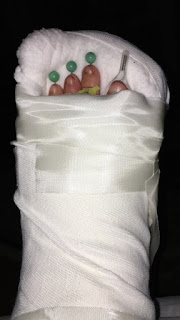
5 surgeries later, and my lower extremities are looking good. The pins will be removed in less than 2 weeks, and I will begin relearning how to walk, using specialized braces and forearm crutches. Out of state specialists will be joining my medical team, as there has been a high suspicion I was born with a spinal cord disorder called Tethered Cord Syndrome. TCS is when the tissue of the spinal cord is tethered to the tail bone. This is a condition that is closely associated with Spina Bifida, and most of the time, TCS doesn’t show up on imaging.

When I think of TCS, I visualize my spinal cord as a rope, tied to my tail bone, and slowly it’s freying. When i move my back or legs, I feel the rope pulling harder, making my legs extremely spastic. I painted the rope wrapping around my legs to symbolize my spinal cord controlling the spasticity in my legs.

I was referred to a neurosurgeon, who specializes in EDS and Tethered Cord Syndrome; usually EDS is correlated to TCS. At my first appointment, I learned the terms spasticity paralysis. Spasticity paralysis is when specific muscles are continuously over-contracting. Spasticity is caused by damage to the brain or spinal cord. The continuous contractions I experience are involuntary, meaning I can’t control when these occur.

This is just the beginning, and we are making progress finding the root cause. I feel a sense of closure, knowing answers are developing. I’m ready to close this chapter in my life, and begin the next one.

Saturday, May 26, 2018

How I called my Doctor ‘Kramer’ During My Surgery

I’ve always believed laughter is the best medicine. To me, laughing helps distract me from the fear and anxiety. I am feeling. I was first diagnosed with Complex Regional Pain Syndrome (CRPS) when I was 11 years old. CRPS is a neurological disorder that affects the sympathetic and autonomic nervous systems. Often CRPS develops in a limb, after a trauma to the body, and it impacts everyone differently. It is categorized as the most painful condition on the McGill Pain Scale; it is rated higher than amputation or having a child naturally.

During my junior year of college, my pain doctor suggested a spinal cord stimulator trial to see if this was a good fit for me. This is an implanted device that sends electric currents to your spinal cord, to help treat certain pain conditions. Any time I undergo a medical procedure, my family would spend the evening with me the night before to keep my spirits up. For some reason, I have always thought my pain doctor resembled the character Kramer from Seinfeld. The night before my surgery, the discussion of my doctor’s resemblance to Kramer entered the dinner conversation. I remember my brother asking me if I had ever seen “The Junior Mint” episode. When I replied that I hadn’t, my brother shook his head in disappointment, and told me I had to watch it that night. Long story short, Jerry and Kramer observe a surgery being done in the hospital’s teaching theater. Kramer drops a junior mint from the viewing gallery, and it lands in the patient’s body.

The next day I had the procedure, and everything went well. I remember waking up in the recovery room and looking over at my dad, who could barely contain his laughter. I asked him what was so funny, and he responded, “You called him Kramer.” I didn’t believe him, and told him he was lying. His next response was the icing on the cake. “No, you called him Kramer, and you told him to not drop a Junior Mint in you.” Let’s just say I woke up pretty quickly from anesthesia realizing I just called my pain doctor Kramer.

When I went back to school after my procedure, I was telling this embarrassing moment to my roommate, and she was in tears laughing. She majored in graphic design, and was always on her laptop working on different branding projects. She was working on something and started laughing. When I asked her what was funny, she told me that I’d see soon. Twenty minutes later, she designed, printed, and put together this white box. On the box was the Junior Mint logo, with pictures of both Kramer, and my surgeon’s face. As we were hysterically laughing, she commented, “You know you are giving this to your doctor.” I told her there was absolutely no way I was bringing that box to him.

Well, the box somehow landed up in my bag, and it came with me to the appointment. I was having an internal panic attack as I had no idea if he would bring up the subject first. The appointment lasted 30 minutes, and I thought I was in the clear as the Kramer discussion didn’t come up. As the doctor was wrapping up, my dad chimed in, and mentioned I had a gift for him. At that moment, I thought I was about to piss myself. I looked over at my doctor and said, “I’m sorry for calling you Kramer, and telling you not to drop a Junior Mint in my back. When I told my roommate this story, she felt it was necessary you had this Junior Mint box to remember this moment.” He looked at me, and started hysterically laughing when he saw the box. His comment was priceless, and something I wasn’t expecting. “That’s what you were trying to say! You kept saying something about Kramer and a Junior Mint, and I had no idea what you were talking about!” Seven years later, I still call him Kramer, and he still has the Junior Mint box I gave him.

Thursday, February 15, 2018

What it feels like to sit in pre op once again

As I walk into the pre op room at Faulkner Hospital, I’m greeted by a familiar face who states “onto another surgery?”  I smiled and said “4 surgeries later, were finally tackling my right side”. She is the sweetest secretary, and last time I saw her, we were discussing about a company that will deliver edible raw cookie dough. I was in heaven eating that, and I thank my friend Kerry for sending me such a thoughtful surprise. 

I’m sitting in the same chair I was last time, and everything still smells the same: sterile. I’m looking at my phone, and talking with my friend who accompanied me, and I noticed I felt a sense of ease; my right foot will be tackled in 7 days, and I can close this chapter in my life.

As much as I don’t want to undergo the pain with the recovery, I am ready to get this done. I have seen how far I have come with my left leg, and the pain will be worth it when I’m able to stand on my right foot without my toes being contracted. I often think about how I want to celebrate having my feet again when these surgeries are completed. For me, I want to feel the sand in between my toes. 

Going through surgery is never easy, and I remember being terrified going through this not even a year ago. I had so many thoughts and emotions going through my head, but the biggest thought was “how am I going to cope if the surgeon couldn’t save my foot?” This time around, that concern that was clouding my brain has diminished. Am I scared, absolutely. Who wouldn’t be, as surgery can be nerve wracking. The primary difference between this surgery and my first surgery, is I feel confident. I have faith in both my surgeon and myself that things will go smoothly.  I am going into this surgery knowing I will wake up with my toes. 

Tuesday, February 13, 2018

It can be hard to open up to others

The last couple of weeks I can tell I’ve been isolating. I always have people around me around the clock, and it’s hard to have alone time. My alone time is at night, and many times I want that time for myself. I want to be independent, but it’s difficult when I need help with basic tasks. I have a hard time opening up and telling others how I truly feel, as I don’t want to be a burden. My health issues is the main thing that is going on in my life, and it gets tiring talking about it. Who wants to hear about ongoing medical issues that may bring your spirits down? There are many things that I have going on that are non medical, and at times, it is difficult embracing these things. 

I have a large support system, but it’s difficult to reach out and say I need help. Some days are easier than others, and I’m doing the best I can to open up. At times, I’m afraid to tell someone how I truly feel, as I’m sensitive to others who may have opposing views. 

Currently, I am trying to be as independent as I can, even if it may not be the safest decision. In my eyes I see it as ‘let me enjoy it until it’s taken away from me’. It’s difficult to transition from walking, to being wheelchair bound for more than 3 months. Yes this is only temporary, but it is still hard for me to accept that I have to do this. 

Art has been my outlet, and I’m trying to push myself daily to do some form of it. I’ve finally gotten back into painting, and I can’t allow myself to take a break from it again. For a period of time, I had lost my drive to create. Lately I will put music on, and paint for 4+ hours at a time. For me, painting is an outlet; I feel completely calm, and I am focused on the process of creating. 

I want to be the best version of myself, and that’s a work in progress. My top priority is to work on loving myself for who I am, and accepting my new norm. There is no quick fix for this , just continuing to do my best everyday. 

Saturday, January 27, 2018

Surgery Numbah 5: Getting Closer to My End Goal

The next surgery has been scheduled, and it is hard to explain how I feel; the surgery will be done within under a month, and the surgeon will be focusing on my right foot. The game plan for this surgery, is the same as the left foot, and I am still facing the same chances of amputation. Even though the left foot surgery was successful, the surgeon has made it clear he is unsure if he can make that happen again. The game plan will be to sever the tendons of every toe, remove bone from each toe, and perform a fusion on my left joint where the big toe is. The plastic surgeon will be in the operating room as well, as the surgeons' are keeping a low threshold for amputation. The surgeon has explained if there are issues with the skin, blood flow, and more, he will amputate half of my foot right then and there. Currently I have 3 toes that have been breaking down, to the point skin is missing. I am keeping my spirits up that I will have my toes back, but I am being realistic that there is a good chance I could lose half of my foot.

 The range of motion in my left ankle looks great, and we are all estatic with the progress that has been made. I attend outpatient physical therapy two times a week, and continue at home physical therapy 2-3 times a day. Daily I set myself goals, and I push myself to accomplish them, even on the days I want to curl up in a ball and cry. I am making sure to listen to my body, and allowing myself to rest when my body demands it. Rehabilitating my leg is my full time job, and it is rewarding as well as exhausting. I have found ways to implement physical therapy exercises wherever I am, including walking the entire grocery store several times. I have learned simple errands we take for granted, have become rewarding in my eyes.

I was fitted for a specialized brace, known as an AFO. An AFO is a customized brace that supports limbs that may be weak, or assist limbs that are positioned in abnormal positions due to muscle contractions; currently my ankle is still struggling with muscle contractions, and has a permanent foot drop. I'm at a big risk of my left ankle becoming stuck in a permanent contracture again. If this occurs, amputation will be necessary as I do not have any other options to reverse the damage. When my foot isn't in the AFO splint, my foot flops down and locks up in muscle contractions. To prevent my ankle going back into a fixed contracture, it has been recommended to wear the AFO at all times, with exceptions for showering and physical therapy. What has been difficult is my leg is continuing to fight the brace. My heel is unable to sit properly in the AFO brace, and it continues to slide up and out of the brace. Envision pushing down on the gas pedal in a car, but instead of releasing off the pedal, it is stuck pushing down; that is what my ankle does daily. There have been multiple times my leg has gotten out of the brace, and there has been an incident where my foot was forcing itself out of the brace. During that occurrence, I was unable to put a finger in-between the strap of the brace and my foot/ankle. The surgeon and my physical therapist were notified, and they were confident this was from the dystonia. I met with the brace clinic, and learned that I am running out of options for how to keep my ankle immobilized. I will meet with the brace clinic again next week,  and further adjustments will be made to the brace. My surgeon has referred me to a colleague who specializes in neuromuscular diseases, and this provider was consulted originally for my first left foot surgery; the fun fact about this physician is he was the one to suggest the surgical method to save my foot originally. Botox is being considered again for my right leg, and further discussion will arise about what options I have left for my left leg.

I am overwhelmed with emotions, but there is a relief that I am in the home stretch. It is draining to go through the grieving emotions, but it doesn't feel as intense as a year ago at this time. I am practicing self love and self care, and have been reaching out to family and friends for support. I continuously keep myself busy, between doing work for the RSD association, and creating art. When I start feeling down about the situation, I look at my left foot, and wiggle my toes; I smile every time I see them, as I am lucky to still have them. Making the decision to undergo this extensive surgery again hasn’t been easy. Signing paperwork allowing my surgeon to make the decision to amputate is difficult, but I know he will make the best judgement. When it comes to RSD/CRPS, any surgical intervention that is necessary has to be thought out in depth. The more trauma my body encounters, the chances of the RSD/CRPS spreading increases. Every person who has RSD/CRPS responds differently to medical and holistic approaches, and its crucial to figure out what works for you before undergoing any procedure. For me, I respond well with Ketamine, and medical marijuana; my treatment team is insisting both of these approaches are incorporated in the recovery process, and I was hoping they would prescribed frozen yogurt, and chocolate as well (a girl can dream, right?).  In my eyes, there are to many pros that outweigh the cons, and it is completely worth undergoing this procedure; I am not giving up my goal of being able to walk.

Monday, December 11, 2017

7 day hospitalization, and I have never been so happy to be home

As I am finally laying down on my bed, I can take a deep breath, and snuggle into my own bed. This was a terrifying 7 days, and and some of the admission I don't have recollection due to the amount of narcotics benzodinpines, and muscle relaxers to try and control the pain. What is difficult with CRPS, it tends to not respond to every medication or treatment method, and you have to try every option in hopes for relief.  Often patients are told ‘this is all in your head’, and it can take an emotional toll on you. Growing up I was often told the phrase ‘suck it up and live’, so I often ignored the pain and continued to do the things I loved. CRPS acts like a monster, and only responds to when things are his way. But that is how I think of the disease. It has a mind of it's own, and you have to find the right cocktail to make the CRPS have a nice buzz going to make him happy. What s tricky, is every person responds differently. CRPS is categorized as a neuromuscular disease. My case of CRPS may look different than some of my closest friends as we have similar symptoms, but are affected differently with comorbidity conditions. Think of a snowflake; there isn't an identical one. The same theory applies to CRPS. I will never know what it feels like to be in their shoes, and vice versa. But what is amazing about what you meet someone with a chronic illness, there can is an automatic connection. You may not be friends with them, but you will feel respect for them because you understand that they are fighting a difficult battle.


On Tuesday November  28th, I went for allergy testing, as I was having anphlactic reactions to cherries. I still laugh at the idea of being allergic of being not being able to eat it because it is so random. But for me, it severe, to the point I stop talking. The way you are tested is by a skin test, and I was reassured that there was little risk of going into anaphylactic reaction. Oh haiiii I was that girl that had to be the in the little risk category. The test revealed so many allergies, that my body went into heigh wire not only with an allergy attack which shocks your body. With CRPS its shocks your body to the extreme. Your body is extremely sensitive, especially to trauma. The trauma could be minor, but it could piss off the CRPS monster. It is not uncommon for one to go into a flare, after having multiple traumatic events occur.

I have learned how to identify which symptoms are related to CRPS, and the same with Dystonia, but this was a completely different kind of pain. The pain was going up my left flank, and down my groin and abdominal area. I had been having cramps for a couple of weeks, but I didn't think much of it. By Thursday evening I was hunched over vomiting and having the chills from the pain. I was struggling to urinate, and could feel so much pressure, along with shooting pain that would come and go. I was hunched over, and any time I moved I was in tears. My dad and I went to an urgent care, and they sent us immediately to the local hospital as the physician felt I had a kidney stone.

When I got to the closest ER, we tried to rule out a uti, but I wasn't able to give a sample. A cat scan was done as there was questioning about a kidney stone. The results came back negative, and I was discharged. I emailed my pcp, and got in to see her the next day. After I caught her up with my symptoms, she was concerned about my kidneys, bladder, and spine. She wanted me to be seen in the ER that was affiliated with the partners systems, and she didn't want to wait. She sent me to Faulkner.

When I was at Faulkner, I was greeted by a triage nurse who's voice was familiar. When I saw her face, I realized it was someone I grew up with in first grade, and we danced together. It was a little embarrassing to tell someone you know and haven't seen in years about your medical stuff, but it almost felt comforting when you're trying to remain calm. I'm thankful she was there, and she is truly an amazing human.

It will take time for the effects of the medications to get out of my system, and it has caused some unpleasant side effects that affected my internal organs. I was loosing sensations in areas of my body that was frightening, and this left the doctors nervous that neurosurgery may have to get involved. The doctors knew I was going to be admitted, but there was debate if I should be treated at Brigham and Woman's as I have specialists there. I remember crying as I was frustrated, and just wanted to go home. I remember my friend who was my triage nurse pop into my room right as she was about to head home off her shift. I caught her up with everything as tears are rolling down my eyes. She gave me the biggest hug, and reassured me that she was here if I needed anything.

It was recommended I be transferred to Brigham and Woman's. After being in the ER and having another cat scan performed, and was brought to a room three hours later. When meeting with the specialists, they were confident my SCS cords had migrated, and it was stimulating my abdomen and bladder. The down fall was they do not do work with the manufactuer that makes my specific stimulator. If this is what was occurring, then I was facing neurosurgery to correct the misplaced leads in my spinal cord.  I don't remember much of this stay as I was heavily sedated with every form of oral and IV pain medication. I was unable to void, and would need to be straight cath'd every 6 hours

My pain doctor was contacted and a plan was made to be discharged Monday morning, and I would see him in clinic. As my dad and I listened to the nurse explain the discharge instructions, we were speechless. "If she is continuing to retain urine in 24 hours, go to the emergency room; Just not this hospital. When I was discharged I was retaining to the point of having severe abdominal and back pain. The only comfortable way to lay was in the fetal position. If this is what it feels like to have kids, I am not doing it!

When I was discharged, my dad drove me to my pain doctors office, my pain doctor was confused with what was going on, and why I was hunched over crying. We had explained what had happened at the previous admission/discharge and his response was priceless: "wait they discharged you and you can't pee. How the hell am I going to fix that?" He told us that he received a phone call that I needed an urgent appointment, but there was no communication about the situation. When I usually see him in a good mood and we talk about life, and this is the first time I saw him fuming and flustered about the situation. I've been seeing him since I was 19, and I call him Kramer as he looks like a mix of Kramer from Seinfeld and Al Pacino. Kramer explained that there was no way my leads could have migrated as they have been implanted for 7 years, and the scar tissue healed it to be in the proper places. He felt the hospital discharged me because it wasn't their programing they use, and there was nothing else they could to do to help. This was the best thing that could have been done. I described my symptoms of the severe amount of pain I had in my back,He was concerned that one of the discs was pressing or causing issues with my bladder. He admitted that my back issues were brushed under the rug and something was actually going on. When Kramer looked at my CT scans and reviews, he revealed that I had degenerative disc disease, and two herniated discs at my L4 and L5.  911 was called, and I was shipped off to Beth Israel as we were fearing my spine was compressing my bladder.

When I got to the ER, more tests were performed, and I was admitted. Neurosurgery was consulted and they said my spine wasn't pressing on anything. I had every medication in my system, but the two important medications were never provided for a week; these medications are for my anxiety, as well as my ADHD. When I am not on this meds, it is extremely noticeable; not only do I see a difference, but others can as well. These are two meds that should never be stopped cold turkey, and going through a traumatic event is probably the worst time these medications were stopped. I was a hot mess. I remember being in the bathroom trying to urinate, and if I couldn't I would need to have a foley to help. I called my therapist and bawled my eyes out of how scared I was. My mind was racing endlessly. There was so much unknown, and I was scared shitless. The neurologist that was assigned to my case suggested I should see the same neuropsychiatrst that first diagnosed me with a conversion disorder. This is a sensitive subject, and I have trust issues with doctors after what happened in the past. I have had so many doctors who have not believed my pain is real, and that has left me feeling guarded when I work with providers. Having flashbacks and severe anxiety without your medication is horrible. My head was spinning in every direction, and I felt depleted physically and mentally.

I met with the pain team on Wednesday, and it was agreed to stop any opioid pain medication and muscle relaxer that was being pumped into me. The doctor asked me what I use for pain control at home, and my response was medical marijuana and ketamine. We were talking about how beneficial these forms of treatment can be, and I told him about how much ketamine infusions helped me during college. The hospital did a way with infusions years ago, and it had to be rare circumstances to have it done on an inpatient level. The goal of the infusion was to reset my nervous system, and get it to a manageable level, so I could go home. After the physician spoke with another colleague who works closely with Kramer, it was recommended a 12 hour low dose ketamine infusion be administered. It was a difficult night as I was bombarded with visual and auditory hallucinations, as well as paranoia. The nurses taking care of me were fantastic, and were so kind and compassionate reassuring me I was  okay. The nurses acted very quickly when the side effects were increasing, and the doctor responded as quick as he could. Within minutes I remember a nurse holding my arm reassuring me I was okay as she pushed a sedative to calm me down. I remember crying to her and saying thank you.

When I woke up in the morning, my infusion had a few hours left, and I felt so much better. I was in a complete haze, and the pain was tolerable. The pain doctor came in, and he sat down next to me and we were shooting the shit cracking jokes about the side effects I experienced, and was curious about the hallucinations I had and what was it that triggered them. He explained he expected me to be affected by the side effects, and he talked about how he made a very short clear message warning my nurses that this most likely would happen. I thanked him for making this infusion possible and we suggested that my upcoming surgeries Ketamine continues to be involved for pain management along with non-opoids medications, as I am hyper sensitive to opioids causing internal organs to not work properly or at all. These doctors were truly wonderful, and they both went over and beyond to make sure we could figure out a plan. You could tell from his mannerisms that he cares for his patients and wants to make a difference. After talking for a bit, he had a shit grin on his face wanting to know the details of what I could remember from the hallucinations. He had me hysterically laughing at what I could remember, and it is true when they laughter is the best medicine.

Before I was discharged, one of the pain doctor's asked if I was in counseling, and I was open and told her and her colleague I go weekly. It was recommended I increase my counseling sessions to a couple of times a week, as it may be beneficial to receive some extra support. As each day has passed since I was discharged, I am remembering more of what occurred, as the medication is slowly getting out of my system. It has been quite the rollercoaster, and I'm worn down physically, mentally, and emotionally. Since being discharged, I have been forcing myself to keep busy and moving continuously as I know the minute I stop to rest, the emotions take over, which is usually at night. It has been difficult to accept what I can't control, and learn to adapt, particularly obtaining to my health. I have been doubted for so long that my pain isn’t real, and I at times doubt myself that I’m over exaggerating about the intensity of  the pain. I always wonder how can I suck it up a little more, and I’m realizing I can’t act tough anymore. I will always be strong, but I need to be open with myself and others about my fears with RSD and Dystonia.

I am starting to reach out to others about what has happened, as I know this is the time I need some extra support. My dad, brother, and sister in law were unbelievable during this time, checking on me daily keeping my spirits up, and being by my side through it all. I’m grateful for every person who checked in, even if I couldn’t respond back. Just knowing the amount of support I have, makes me realize I’m not alone in this journey. All the nurses I had were wonderful, and I have so much respect for anyone who is in the health care profession. I'm thankful that the pain team at Beth Israel for all they did, and advocated for what I needed.


Wednesday, November 29, 2017

It is possible to succeed when you get knocked down

It’s exciting to finally be at the point I can begin to rehabilitate my leg. Last week I met with the surgeon, and was given the clearance to walk with crutches. It was determined I will need an AFO brace to provide stability to walk. This is a specialized brace that provides support to control the position and motion of the ankle. This brace compensates for weak limbs, as well as position a limb with contracted muscles into a more of a normal position.  I had the AFO molded to my foot, and it reminded me of the process done when a plaster cast is put on someone’s limb. It will take 2-3 weeks for the AFO to be made, and then I will be able to take it home and officially wear a shoe. It has been 2 years since I have worn any form of a real shoes, as my feet was too contracted to fit into anything. 

For a good period of time, I didn’t think I was ever going to walk again. I felt like I was watching life with very dark sunglasses caked with dirt, in a pitch black room; the only light was distant, but not possible to recognize. Nothing seemed clear, and I had to use my other senses to trust thing would get better as I couldn’t see. As things began to look up, my sunglasses began to clear around the edges. I would take one step forward, and 4 steps backwards; my sunglasses became caked in dirt once again. It’s hard to stay upbeat and positive when so much is out of my control. At one point I felt like everything was my fault. As I am getting my ‘walking privileges’ back, the dirt is scraping off in chunks. Physical therapy  begins next week, and layers will continue to crumble away. 

As the casting for my AFO was being done, it began to dawn on me that this brace is the next piece of equipment that will be life changing for me. To think this time last year, customized  shoes were made for my contracted feet, and would eventually be adjusted so adapt half an amputated foot. I remember driving home from the appointment with one of my PCA’s and having tears roll down my face. I felt sad and alone knowing that I looked different. I already felt like I stuck out like a sore thumb for using adaptive equipment to help ambulate, and these shoes were a dead give away that I looked different. These shoes looked like they were meant for Mickey Mouse’s feet. I wore those shoes once, and I will always keep them to remember how far I have come. 

I have uneasy feelings knowing I will always need a brace on my leg, but then I remember this could have been so much worse. I was told I would wake up with half a foot, and if I didn’t have surgery to correct the excessive damage, I would never walk again. At one point in the beginning of my dystonia journey, we were unsure if I would regain the ability to walk again, leaving me wheelchair bound. I refused to give up because I knew things would get better. I always had hope I would get back to where I left off two years ago, but I’m glad life steered me in a different direction. I never wish what I went through on anyone, but I learned many valuable lessons about myself through out this period:
  1. Resources are available for individuals who are disabled. It takes a lot of patience, but there are options. The disability community has to stick together, as they can be more knowledgeable than many providers. 
  2. SSI/SSDI is a corrupted and broken system. If you have a disability, you have to fight all you can to receive assistance as there are many individuals who abuse the system. 
  3. Self care is critical. If you don’t take care of yourself, you will never heal and be happy with who you are as a person. 
  4. It is okay to cry and be angry. Never bottle up how you truly feel, as you are doing more harm than good. 
  5. I refuse to give up, even when the hardest obstacles have been chucked at me. 
  6. Never give up fighting for medical care, even when health insurance is putting up a fight. Health insurance can be a b***ch.
  7. It is okay to accept help from others. 
  8. 3/4 of a masters degree in social work taught me how to be a case manager balancing all my medical shenanigans. 
  9. If you don’t take care of your mental health, it will lead to further issues.
  10. When life gives you a bag of ultra sour lemons, be patient as sweet lemonade can be made. 
  11. If you can’t laugh about difficult situations, then the healing process will be delayed. 
  12. The only option that matters is your own...and maybe the dog’s 🤷🏻‍♀️
  13. Asking for help doesn’t mean you’re weak. 
  14. Be honest with yourself.
When life knocks you down, there is always a way to pick yourself back up. Reach for a hand, and ask for help; there is always someone there to cheer you on. I am extremely grateful I have supports who have and continue to  help me get back on my feet (literally). Without leaning on others for help, I wouldn’t be where I am today. When you live with a chronic illness, you never know what the next day will bring. Instead of worrying about the future, appreciate the present moment. Look at what you are grateful for, and note the positive moments. Even if it was a no good really bad day (such a good book), there is always a positive moment hiding in your peripheral vision. When it is hard to see clearly, take a step back, and adjust those filthy sunglasses. When you clear away some of the dirt, positive moments are in the corners where the dirt rubbed off. 

Friday, November 10, 2017

Having a chronic illness will keep you on your toes

At the age of 20, I had a spinal cord stimulator implanted to help my RSD. A SCS is the idea of a tens unit; the difference between the two is a SCS in internal. The purpose of a SCS is to mask the pain signals before it hits the brain. Paddles and wires are implanted in my spinal cord, and a battery is placed in my lower back/hip region. What’s really cool is I have a remote that controls the stimulation, so it gives me the ability to adjust and change different sensations in different areas of my limb. The battery that is implanted has to be charged once every 2 weeks, as well as the remote. Even though the battery is rechargeable, it has to be replaced every 7-10 years. 

For the last year, I have been having issues with my stimulator battery. Lately the battery has to be charged every 2-3 days, and it does not hold a charge. The only way I can charge my battery is if I am sitting in bizzare positions. I had an appointment with my pain doctor, and 2 hours was spent trying to reprogram my SCS. After talking with my doctor and the Boston Scientific rep, it was agreed it would be in the best interest to change out my battery ASAP. 

I received a phone call on Wednesday from his office confirming  my surgery for November 15. My doctor wasn’t joking when he said he wanted this done ASAP! My SCS has helped me in so many ways, and this is a resource that I benefit from greatly. The procedure seemed simple when it was explained: open up my back, pop out the old battery, pop in a new one, sew me up and call it a day. It’s an outpatient procedure, so at least I can be comfortable at home.  It’s never easy to go through surgery, and Im not going to lie 4 surgeries in a 1 year span is intense.

 I realized that this upcoming surgery is actually a milestone; after this procedure, all the surgeries on my left leg will be done. Technically I am half way done with my surgical journey! It’s such a rewarding and satisfying feeling seeing how far I have come mentally and physically.When you can see the eye on the prize, it makes you fight harder so you can win.. Keeping an open mind can be quite challenging in the beginning, but it gets easier as time goes on. When you’re having a difficult day, think about the things you are grateful for. It could be as small as getting out of bed and taking a shower, or sitting outside getting fresh air. I could give a laundry list of everything I’m grateful for, but today I am extremely grateful I will be getting a new SCS battery. 

Saturday, October 21, 2017

Friends Love You For You

“Friends are like your backbone. They are always there when you need support” (iliketoquote.com). Friends are there for a reason, and want to help when things become difficult. When you need to cry your eyes out, sometimes you need someone to listen. There may not be anything a friend can say that will make the pain diminish completely, but knowing someone is there can help tremendously. 

I am a type of person who will drop anything for my friends, but I do not take the time to care of my emotional well-being when things become difficult. I never want to complain to others about what is going on with me physically or emotionally. I grew up learning that others do not want to hear about the negatives in your life, so I tend to focus all of my energy with on the positives; I’m learning this may not be a healthy motive all the time.

While being on the phone with a friend, I noticed I had tears rolling down my eyes. The tears were not directly related to my physical pain, but the emotional pain I haven’t processed yet. As the tears flooded out, a sense of calmness arose I felt like a weight was lifted off my chest. I continuously thanked my friend for listening to my nonsense and she replied gently: “I love you and I want to know what’s going on in your life. You’re going through more than someone should, and you have to open up to others and tell them. You can always come to me”. 

I can’t be afraid to tell people how I truly feel, otherwise I will be alone handling life situations. Friends can be great support systems, and if they really care about you, they will be there for you during the good the bad and the ugly. Sometimes you need the reassurance that it’s okay to reach out and ask for help. If friends truly care about you, they will not judge you; they only want what is in the best interest for you.

Friday, October 13, 2017

24 Hours After Surgery

Yesterday I had my third surgery on my left leg, and I’m excited to say we are all confident this is the last surgery for this leg. Before I went into the OR, the surgeon explain when my muscle tore last week, it actually helped in regards to the surgical process. When it tore, it lengthened my achillies, but not enough to eliminate surgery in total. Before the surgery was performed, a nerve block was done, and it was agreed that a ketamine infusion be performed while I was under anesthesia. Ketamine can be beneficial for individuals who have RSD/CRPS as it can slow down/prevent spreading of the disease. 

When I woke up in the PACU, I was feeling pretty good and wanted to go home. I didn’t see the surgeon when I woke up, but he did speak with my dad about how surgery went. The surgery was successful, and the surgeon was able to lengthen my achillies without difficulty. He was not concerned about my achillies rupturing in the future, and did not feel it would have the be severed (THANK YOU LORD). He also explained there is a 50/50 chance I will need braces on this leg, which left me feeling really hopeful. 

At 8:00 last night, I recieved a voicemail from my surgeon checking in on me. He said how well I did in surgery, and woke up immediately after it was over. He talked about how happy he was, and is confident this is going to help. I was shocked I got that message from him, as I’ve never gotten a call from him checking in on me. I was smiling as I listened to this, and kept thinking I am blessed to have a surgeon that truly cares. 

Sunday, October 8, 2017

Taking Care of Your Mental Health is Important

Everyone goes through some form of pain, and handles it in their own way. This pain can be physical, mental, or emotional. There is always help for anyone that may be struggling, but the first step one has to take is reaching out for help and accepting that you can’t solve your problems independently. It’s hard to admit when you’re struggling, and can be embarrassing to ask for help. There are many thoughts that can go through one’s mind about how others may view you for needing help. For a long time I was afraid of what people would think of me for asking for psychological help. After going back and fourth with myself for a while, I finally told myself to cut the shit on procrastinating and ask for help. I was tired of being afraid of what others thought, and I needed to put myself as a priority.

I entered counseling two years ago, as I needed help. I was struggling coping with all that was going on, and was spiraling into a deep depression. It was difficult to accept that my life was drastically changing, and I would have to learn how to adapt being permanently disabled. I was sad about everything, and had a laundry list of things I was grieving about: loss of independence, not being able to finish school, limited mobility, and loss of relationships. I hated how much was out of my control. Every doctors appointment that I would go to, I would leave there bawling my eyes out as doctors were stumped and couldn’t help. It was mentally draining hearing doctors continue to blame my symptoms to my psychiatric issues, even though I knew something more was wrong; I felt completely hopeless. I was tired of being labelled as a drug seeker, and I felt like no one was listening to me. I stopped being social, and struggled reaching out to close friends. In my head, I felt the people I loved wouldn’t want to spend time with someone who is constantly in pain with an unknown reason of why this was occurring. I felt like everyone was judging me, and thinking I was making this up to get attention. This was a time that I felt alone, and no one understood how much emotional pain I was feeling. 

I became defensive towards providers and would have my guard up ready to fight back. Doctors were dismissing my situation, and I was determined to prove them wrong. My gut was screaming something wasn’t right, and my heart sank when I learned that my gut was right. The day I learned I was facing amputation, is when I started giving up on myself. I was so angry it took so long to figure everything out, and all I could think of was the comment multiple providers repeated numerous of times: “you should have came to us sooner”. I truly felt defeated.

I was devestated and furious with myself. I started mentally beating myself up that I should have done more; I was convinced this was my fault. I became hyper focused on trying to figure out what caused my legs to develop dystonia, and continued to harp on what I should have done differently. I knew things were going to get better, but the feeling of failure would not go away. I became so sad knowing I needed amputation; I wanted to use my legs all I could. I began walking around the house without my crutches, forcing all of my weight on my contracted/paralyzed toes and frozen ankles. In my mind, I wanted to enjoy using my feet all I could before they were taken away from me. When looking back at this period of time, I recognize how unhealthy this behavior was. This was the only control I had, and I felt like I deserved to be in pain. 

I remember having lunch with a close family friend, who disclosed how concerned she was about me. She is a neuropsychologist, and is someone that I have always respected and viewed as a big sister figure. She urged me to get myself into counseling to do trauma work. She looked at me and said that it’s worth the emotional pain to take care of yourself. This was the best advice I have taken from someone. 

I increased my counseling sessions to twice a week, and was consistent going to them. I wanted to get my life back, and I was willing to do the work. I began utilizing cognitive behavioral therapy (CBT)  with my therapist, and did self help workbooks independently so I could incorporate CBT daily. Medication was adjusted in hopes to to help with my anxiety, depression, and ADHD on a chemical level. I encorporated mindfulness, and started using the creative arts as my form of meditation. Painting was always somethings I loved, but I lost the drive to continue. I forced myself to do some form of art weekly, whether it was painting, writing, or knitting. I focused on holistic approaches to help with my pain management, and would learn that is also helped my mental health. I got myself involved with the Reflex Sympathetic Dystrophy Association (RSDA) and started doing work with their peer mentor program and became a member of their grant committee. 

It has been 8 months since I started counseling twice a week, and it makes my heart happy to see that my hard work is paying off. I’ve noticed I am happier and calmer all around, and my anxiety/depression has been decreasing substantially. My anger has been diminishing, and I feel like myself again. My anxiety will creep up at times, but I’m able to intervene and use healthy coping skills to help with these feelings. Im not afraid to ask for help when I need to vent, or even sob my eyes out. Growing up I have always hated the word patience, and it is now one of my favorite words. When you put in the work, be patient and you will see positive results. 

The best gift I could have given myself was to take care of my whole self. There is still work I need to do, and I will continue to dedicate my energy on getting better. When life becomes difficult, hang on because it will get better. Reliving painful memories is never easy by any means, but it will strengthen you as a person. The strongest thing one can do for themselves is ask for help.

Friday, October 6, 2017

Muscle Tear 6 Days before Surgery

I have been experiencing a lot of pain that feels like something is tearing/ripping in my leg. We knew there was a possibility that my achillies would tear on its own, but this was something we were not too concerned about. Our understanding that if my achillies tore or ruptured, it would not be the worst thing.  On Tuesday I woke up and found a lump on the side of my calf with severe pain. As the day went on, the swelling increased, as well as the pain. If I moved my leg, the tearing sensation would increase. I put in a call to my surgeon who was pretty sure my achillies had torn on its own or was beginning to tear slowly. The doctor wanted me to call him the next day, and update him on the status of everything. 

After being awake all night from the pain, I looked at my leg and it was bigger than it was the night before. It looks like a baseball is popping out of my leg. I called the surgeon and was told to come in and see his physians assistant. When I saw her, she said my achillies was in tact, but I did have a torn muscle where the ball sized lump was. She said there’s a possibility my achillies is tearing but we will not know that for sure until I go into surgery. There is questioning if I have damage to a nerve as I don’t have sensation in half of my foot and heel, or is the swelling causing the numbness. The only way to correct this is with surgery, which is in 6 days. It was recommended I stay off my leg as much as I can due to the swelling, and it is crucial the swelling stays down as it will impact my surgery negatively. 

As much as this situation stinks, it’s nothing I didn’t expect and it could be worse. The appointment overall was positive, and I am grateful there isn’t signs of a blood clot. The treatment plan for the time being: puppy snuggles and binge watching shows on Netflix 


Sunday, September 17, 2017

Cannabis can be healing 🌱🙏🏻

After my freshman year of college, I vowed I would never smoke pot again after a really bad trip. Fast forward 4 years later, I would never expect to have a  conversation with a relative about whether marijuana could help my pain. This family member had always viewed holistic approaches as beneficial to the whole self, and I have to admit that this person was right. 

In 2015, I got my medical marijuana card, as it's been legal in Massachusetts since 2012. I was really interested learning as much as I could about cannabis. I wanted to understand the laws and regulations, especially as it is still illegal on the federal level. I started reading books and watching documentaries, all discussing how marijuana can help numerous health issues both physically and mentally. The more that I learned, the better I could understand what strands of cannabis may be more beneficial for my symptoms. Its all about trial and error to figure out what is the best fit.

Cannabis has not only been beneficial for my physical health, but it has also been really helpful for my mental health. I have found it has helped with my anxiety, depression, and ADHD. When I use it, my mood is elivated, which has enhanced my creativity. Art has always been a big part of my life, and for a long time I stopped doing it all together due to depression. Since I started taking cannabis, I have been able to go back to doing what I loved; expressing myself. I finally got back into painting, and explored other forms of art, including writing. 

If it wasn't for this relative, I wouldn't have thought 
 marijuana could be used as a form of medication. In the last 2 years of having the medical marijuana card, I have learned so much on how holistic treatments in conjunction to western medicine can really help ones quality of life. Cannabis is a hot topic, and medical researchers are trying to learn as much as they can. The National Institute of Health awarded a federal grant for $3.8 million dollars over the next five years, to study chronic pain patients using opiods vs cannabis as pain management. Currently there are 29 states that have legalized medical marijuana, and there is hope that this number will increase within the next few years. 

Saturday, September 9, 2017

Lack of sleep can really impact your emotional health

With RSD/CRPS, sleep does not exist. I have always struggled with sleep, but especially the last couple of days. Within a 48 hour span, I had only slept for 6 hours in total, which left me as an emotional wreck. I had just had my surgery scheduled for October 12th to have my achillies either lengthened or severed, and I did not fully process how soon it is actually occurring. There are many emotions I am feeling about this surgery, and I haven't fully processed them yet. I am still grieving in many ways, especially with the loss of independence and my mobility. Along with this news, I had a conversation with my NP regarding a conversation she had with my Dystonia specialist, and for some reason I broke down crying. I appreciate that my dystonia specialist reached out to my NP and my therapist, but I was also feeling very sensitive about the subject matter they were discussing. They did not have a bad discussion, but I interpreted it as they did. In the past, I have had doctors accuse me that my symptoms were all psychological, and I had a PTSD flash back of that was what was going on. I know my medical team is strong and finally working together, but this is something I am not use too. For a long time, I had to collaborate with my medical providers, as no one was working together. Because I am not use to this, I am always on guard trying to protect myself, as this is my coping mechanism. I am extremely sensitive talking about Dystonia with my providers, as I always feel that they think I am just a psych case. My symptoms of Dystonia does not match up to any specific form of Dystonia, which ultimately frustrates me as I still feel like providers view me as a psych case. With the limited sleep that I was on, I was even more sensitive, and become defensive. The PTSD that I have from the past is something I am tackling in therapy. There are many people that are afraid to talk about going to counseling, as they may feel others are judging them, or think of them differently. When you find the right therapist, you feel safe, and comfortable to work on difficult issues that are arising in your life.

I've learned that if you don't work on the difficult issues you may be going through, you will do more damage to yourself. It took a long time for me to push myself to go back into counseling, as I had bad experiences in the past. Even though I was in the mental health field, and went to school for counseling, I never wanted to enter counseling for myself. I wanted to help others more that I wanted to help myself. Once I was diagnosed with Dystonia, and was wheelchair bound, that was when I realized I needed help. There were many emotions that I was feeling: anger, sadness, frustration, and isolation are just some of the examples. When I first entered counseling, I was an anxious mess. I was going through a lot of stress, including emotional abuse. At this time I was being bounced around from specialist to specialist being told I was a psych case, and the only person I trusted was my therapist. She was the person to listen when I was ranting that my anxiety was through the roof, and she would help me figure out methods to help me cope. My therapist helped me find resources to help with medical expenses, along with helping me strategize how to approach the medical professionals. It got to a point that I looked forward going to counseling, as it was a third party that could help me rationalize different things that were occurring. One of the biggest things I learned from counseling is lack of sleep can impact the way you think and rationalize emotions. Because my sleep is limited, I can be sensitive to different subjects without realizing it, along with my mood can change without realizing it.

Thursday, August 31, 2017

The creative arts is my form of meditation

Growing up, I have always been very critical of myself. I always felt I had to be the best that I could be in dance, which was something I was passionate about. School was extremely difficult for me, as I have a number of learning disabilities, and was living in chronic pain. I felt so alone, and I knew I didn't fit in. It always bothered me that I was heavier than other students, and I was on a diet at the age of 6. I had a parent who was very judgmental and hypocritical, to the point inappropriate comments were made to me regularly. I was unhappy with  myself because I was different from everyone. I hated that I had medical conditions, that consumed most of my childhood, and I felt family members only viewed me as, "the girl that has too many medical problems and has learning issues"


There was one thing that made me happy, and it was dance. There was something about using movements to tell a story that I always loved. There was never a right or wrong to dancing, it's a form expression. Tap dance was what I loved, and there was something about the repitious patterns and sounds you make with your feet that captivated me. I remember being in English class and having a teacher ask me to stop tapping my feet as it was too much noise and movement for a classroom setting. I never saw anything wrong with constantly moving around, until I was diagnosed with ADHD 10 years later. I look back, and can finally understand why I needed to be constantly moving. Dance was meeting the needs of my hyperactivity, and I was able to concentrate on what I was doing. 

I was always practicing, as I wanted to be the best that I could be. Nothing else was going well for me; I was bullied in school for my weight, learning disabilities, and RSD. And to top it off, I was emotionally and verbally abused by my teachers, and a family member. I have one vivid memory of a teacher tell my parents and I personally, "good luck with your daughter, she's a fuck up". Hearing that would kill any child's self esteem, especially when you know you're different. The dance studio  was my safe place. I knew I could get away from reality for a couple of hours and express myself. It was a judgement free zone, where I knew I could be myself. 

At the end of my first semester of senior year, I had to make a difficult choice and walk away from dance. It was becoming to physically demanding for the RSD, and I was having more issues with flares and treatment. For so long, I was angry that this disease took away something that I was passionate about, but in the end where does anger get you? I miss dancing a lot, but have learned other ways to use the creative arts to be able to express myself. I have always loved to paint, and have found this as my form of self care and meditation. I love to make things for others, as seeing someone's response to the piece is one of the best parts of creating it. I've also noticed I have enjoyed to write. When I am able to write my thoughts and feelings down, it feels as if a weight has been lifted off my chest. 

Because I have found other ways to express myself, my anger has diminished that dance was taken away from me by the RSD. It takes a while to comprehend that there are other things in life that can still make you happy. It's always hard to adapt to change, especially when it is something you didn't expect. I may despise this disease, but I am glad it has shaped me to be the best person I can be. This includes learning how to take care of myself, and learn hobbies that will hopefully develop into things I am passionate about.  


Monday, August 21, 2017

What surgeries I am facing in the near future

I met with the surgeon yesterday, and I didn't think my eyes would be so swollen from the amount of tears I cried. I learned a vast amount of information that left me feeling overwhelmed and drained. The cast was taken off and X-rays were performed. The fusion is healing great, and that's always exciting to hear. My surgeon spoke to the dystonia specialist and the dystonia specialist wanted to try another round of Botox. The surgeon felt this was not going to work, especially since this has been tried 4 other times and was unsuccessful. The surgeon was explaining that it is necessary I have more surgery otherwise I will not be able to walk again. The surgeon is discussing doing a z cut in my achillies tendon, as this will lengthen it. He explained that he may have to severe the achillies once he opens up my leg depending on how it looks. Currently my achillies feels like it's going to tear at any second, and he said that there is a chance that the achillies would tear on its own because of how severe it is contracting. He said if this happens, this would not be the worst thing. He explained that with any surgery I do, I am risking the chance that it will not work, but it is my only option if I want to walk again. He is recommending the surgery be done sooner than later.  

The subject of my right foot came up, as it still needs to be dealt with. At this point my toes are breaking down further,  causing pain and swelling. I have had 2 falls within two weeks, and it was recommended I use the wheelchair mainly. There was questioning of when the surgery of the right foot would occur, and this is unclear at the moment. I did learn that I am facing potential amputation again, as the surgeon is unsure if he can save my toes for sure. We are hoping he will be successful again, but he had to be realistic that this surgery is not guaranteed to get my toes back. 

Once I heard this, the tears were flowing. The surgeon kept saying how much this sucks but he's determined to get me to walk as this is the ultimate goal. People have asked me if I trust this doctor, and my answer is always yes. He is the chief of orthopedic surgeons for Brigham and Woman's Faulkner Hospital, and brought in more than 8 specialists to ultimately decide how to approach my first surgery. I am terrified to know what I am facing, but I know I am in the best hands. 

I cried for most of the day, as this was so much to absorb. I was drained physically, emotionally, and mentally. I was so sad to hear what I am facing, and felt defeated. I kept wondering where is the light at the end of the tunnel? I look at my friends who are my age and I become down on myself  because I am not doing what a typical 20 something year old should be doing. I know my time will come, it's a matter of when. 

I'm exhausted from today's events, and I'm ready for tomorrow to be a new day. Anytime I hear news that is overwhelming, I need 24/48 hours to sit and process the information. Once that time frame is up, I can move on and focus on the things that are important to me that make me happy. 

Friday, August 18, 2017

My Response When Someone Asks Me The Famous Question 'What's Wrong With You?'

Everyday I am reminded that I have a disability. I don't see myself as being different than someone else, but other people have a different perspective. Wherever I am, I am always asked, "what's wrong with you?'. I can understand that my crutches and a giant plaster cast on my left leg gives someone the oppourtunity to open up their mouth's to try and start an innocent conversation. It may be a conversation starter for the other person, but for me, it is a slap in the face and completely inapprorpiate. It reminds me of someone trying to point out a giant pimple on your forehead that you tried your best to cover up with foundation. You try to make it invisible so no one can see it, but in the end, it is still visible to others and you feel embarrassed when someone points it out. 

For the longest time I would become so angry when a stranger would come up to me and probe into my personal life because they see I need an assistive device to help me ambulate. There is one incident I was appalled where a stranger stopped my PCA in the middle of a bank, and asked her specifically what was wrong with me. The best part of this all, is I was in front of my PCA when this event occurred. I remember she was saying that she was mind blown that someone would ask this, and she had never experienced a situation like this before. My response to her, "welcome to my life".

I don't have the energy to explain to every stranger what is wrong with me, so I have decided to use humor as my solution. My automatic answer that I have developed, "it was way too much whiskey and I fell down a flight of stairs". If people know me well, they will understand I have loved Jack Daniels since I was in high school (yes I was that weird person), so I think it's a good excuse. Usually people will chuckle when I give this response, and say that it is a good answer, but others will pry further into my life to get details. If someone continues to probe further questions, I will continue to discuss that Jack Daniels made the injury better, as my discreate goal is for the other person to realize this is a subject I do not want to talk about.

I am usually very open to discussing my medical journey with others, but there is a time and a place to ask me questions. It is extremely uncomfortable to have a random stranger come up to you in the supermarket, stop you in the middle of a task, just to ask why I am in a wheelchair. It has taken a long time to process and learn that sometimes people don't know what to say, and feel that asking questions shows they are concerned or curious. I can see why someone would want to ask and inquire, but I don't think people really realize that it can be a sensitive subject.

It took me a long time to feel comfortable going into public needing a wheelchair, as I was self conscious of myself and the disability I have. I was so tired of people reminding me of something I was so embarrassed of.  It took a lot of therapy, supportive friends and family members to help me realize that my disability is actually a gift. I've learned that it doesn't matter about what you look like on the outside, but you must love yourself if you want to enjoy life. Using humor is my way of coping, as I find it therapeutic. I truly believe in this quote; 'laughing is, and will always be, the best form of therapy'.


A Glimpse into My Life for the Last 15 Years

I was first diagnosed in 2002 with Complex Regional Pain Syndrome (CRPS/RSD) when I was 11 years old after a running injury. I was running in gym class and twisted my left ankle in. The pain kept progressing, and I saw an orthopedist who diagnosed me with Tendonitis and put me in an air cast. The pain continued, and my ankle/foot was turning purple. After going back to the orthopedist 2 more times, the doctor finally told my mom, “I’m sorry but this is all in your daughter’s head. You need to get her psychological help”. After getting in an appointment with an orthopedic surgeon at Boston Children’s Hospital, I would learn of the name Reflex Sympathetic Dystrophy (the name was changed a year or so after to Complex Regional Pain Syndrome). 
CRPS/RSD is a progressive neuromuscular disorder that  affects the sympathetic nervous system. CRPS/RSD usually develops after an injury, surgery, or even something as simple as a blood draw.  CRPS/RSD is known as the 'suicide disease' as many people can't handle the pain anymore. The disease is rated on the McGill pain scale as being more painful than amputation, or giving birth naturally. CRPS usually develops in a limb, but there are cases where individuals are affected by it throughout their entire body. This is known as full body CRPS. The pain is the worst pain one could encounter. The pain feels like you are lit on fire, on top of stabbing, throbbing and aching pain. Think of sticking your hands in a bucket of  freezing cold ice water and not being able to take your hands out of  it. Many people who have RSD  experience muscle spasms and cramping. Think No one really understands CRPS, but the sooner you are diagnosed, the better chance you have to go into remission.
 I would be told that I would need to be referred to a pain clinic, and that this would resolve on it’s own. I would later learn that I would have CRPS for the rest of my life. A common phrase that was heard by my main provider was, “suck it up and live”. I was 11 when I heard this for the first time. I would then try every medication, nerve blocks, epidurals, lidocaine infusions, acupuncture, reiki, herbal remedies and more with no relief.
 At the age of 14, I was sent to Children’s Hospital of Philadelphia (CHOP) to attend an aggressive physical therapy program. The goal was to retrain my brain to understand that non painful stimuli would not make my pain worse. This is known as desensitization and it’s done through physical activity.  Treatment was scheduled Monday through Friday, 7 hours a day. The staff were comprised of physical therapists, occupational therapists, social workers, art therapists, music therapists, and the main doctor. 
The doctor running this programed believed it was crucial to be taken off all of your medication, and treated CRPS more as a psychological issue than a neurological issue. Both the physical therapists and the occupational therapists reminded me of drill sergeants; their approach towards the exercises were aggressive. In PT, I was pushed to my limits with many excercises, especially the ones where I was required to beat my record of the amount of reps I could complete in a minute. If I didn’t do more than my previous record, I would have to do it again. There were many tears, and too many vomit buckets to count. 
After being there for two weeks, I had a few falls to my left arm, and I remember feeling this stabbing burning pain. It was discolored and swollen, and I couldn’t touch it. X-rays were performed, and there was no physical damage to the bone. It was determined that the RSD had spread. 
After being at CHOP for 1 month, I was finally discharged. The pain in my left ankle/foot and knee were  gone but my left arm was horrible.
The pain relief in my left leg lasted for a year, and it was amazing. I went back to dancing 5 days a week, while doing physical therapy on my left arm. There was one day I was in dance, and I felt that familiar pain that I hoped would never come back. I  followed up with my doctor at Boston Children’s who said there was nothing more that he could do for me. 
At this time, I was finishing my freshman year of high school. I would now be on my own handling the pain. My mind set was to ignore the pain, and continue to do the things that I loved: art, dance, and cheerleading. By junior year of high school, I had taken a break from dance, as I  fractured my spine. This recovery lasted for a year and a half. After getting cleared to return to activities, the CRPS was intensifying. I was noticing I was going through frequent flares, missing a lot of school, and it was getting harder to walk. I am amazed and proud to say I graduated high school.
2009 I started college at Lesley University in Cambridge, MA. I was excited to finally have the college experience. I was continuing dance and cheerleading, but realized I really needed help with the CRPS pain. After talking with a family friend, I got the name of a pain doctor who I still use to this day. The best part is he looks like Kramer from Seinfeld. I was his youngest patient at the age of 19. His treatment plan was to do a Spinal Cord Stimulator (SCS). A SCS is a mild electric current to your spinal cord. The goal is to block out the pain receptors by feeling the electric current instead. I went through the trial run, and found it extremely helpful. The trial gave me hope that I could go back to dance. I had my first SCS implanted December of 2011, my junior year of college. I had it done during my winter break. The SCS is a 6 month recovery that requires you not to bend. The pain from the surgery was extremely painful, but my CRPS pain was getting more tolerable, and I found I was finally getting relief. I am so grateful for all of my friends in school who were so helpful and understanding. My friends were awesome for pitching in, and I was fortunate that my professors were understanding. After 6 months, I was back to dancing with my team. Words can’t explain how it feels to go back to something that you loved so much that had been taken away from you for so long. I was so happy, and really felt I was getting my life back. I was doing an art therapy internship with a pediatric inpatient psychiatric unit, and I was interested pursuing a career in social work.
After dancing for a year, I began feeling pain in my right foot. My foot was becoming discolored and was ice cold to the touch. When I followed up with my pain doctor, he confirmed the CRPS had now spread. He felt it was time to try a medication called Ketamine. Ketamine is mainly used during anesthesia, but there is reports that it helps treat CRPS. I would start with ketamine lozenges (it looks like the size of a starburst), and then I would go for infusions. The infusions would take 4-6 hours, and often I would be extremely out of it because of the side effects.
It was exciting to see how much the Ketamine was helping. I wasn’t missing as many classes, my flares were not as severe, and I was finally enjoying college more because the pain was tolerable. I would go for infusions every 8 weeks, while being in my senior year of college.  By my second semester, I started working on an inpatient psychiatric unit specializing in eating disorders, and estatic to learn I was accepted into my top choice for graduate schools. I graduated Lesley University with my Bachelors of Science May 2013 
Fall 2013 I started graduate school, while continuing to work part time. I was really busy, but happy with everything I was learning. My pain was still there but it was manageable thanks to the Ketamine infusions. Unfortunately my treatment approach was about to change, as my health insurance  stopped  covering the ketamine infusions, and the ketamine lozenges. My doctor fought the insurance providers for months, but they wouldn’t budge. Next treatment plan: another spinal cord stimulator for the right side of my body. When I had the first SCS implanted, it was designed to control one side of the body. A year after I had my SCS  implanted, a newer model came out where there is now an ability to get full body coverage. My doctor felt it was best to keep in my first one, and put in a second device. It was decided I would have this surgery done after I finished finals, and recover during winter break.
Two months before my surgery, I started having some issues with my job. Because the ketamine infusions had stopped, my flares were getting worse, and there were shifts I had to call out on. I had met with my nurse manager and had explained about CRPS, and had asked her if she wanted documentation. Her response was no. After a couple of weeks had gone by, I was called in to meet with the Director of Nursing who scolded me for calling out because she thought I was out partying and lazy. (I wish I was joking about this). I started hysterically crying and trying to explain I had a neurological disorder, and made sure to explain that my nurse manager was aware. I explained I was going to be needing neurosurgery again and it is out of my control when the pain flares occur. She asked to get the documentation, and set up a time to meet with human resources to talk to them about this. Once I met with human resources, I learned that my job would not be held when I come back from surgery, and I was let go from my position. 
I had the surgery December 2013, and it was a rough and painful recovery. I would go to classes sitting on pillows, in attempt to try and be semi comfortable. I knew I needed to continue school as a distraction from the pain. Once I got through my 6 month recovery, my  friend helped me get a job working at an emergency room working as a Patient Safety Assistant. Often I would be working with psychiatric patients who were on a section 12, and needed supervision for safety reason. 
Fall of 2014 I started my second year at school, and was assigned my first field placement; a homeless shelter for children in state custody. I was having difficulty balancing work, an internship, school, and RSD. I was offered at my internship an opportunity to be paid to work as a social worker on top of doing my school internship. For me this felt like the right fit as my internship was a shorter commute than my job at the ER.
Summer 2015 I decided I needed to take care of myself, and my whole self. I have struggled with weight all of my life, and had tried many different approaches to lose weight, and I was never successful. I decided to meet with a bariatric specialist, and after a lot of consideration and research, I decided to get the lap band. The lap-band is an adjustable silicone band placed around the top part of the stomach, designed to restrict food intake. At the time of surgery, a small device called a port (or reservoir) is placed under the skin of the abdomen. I wanted to lose weight on my own, but I knew that I needed help. Weight loss surgery is NOT a quick fix to losing weight; it is a tool to help. Weight loss surgery is a complete life change, and I was ready to take on that change. I had the surgery done on August 11, 2015 and I went into surgery smiling because I knew this was going to help my overall health, but especially the RSD. To this date, I have lost 100+ pounds, and I have never been so proud. It was worth the change, and I did not realize how important your diet is especially with a chronic illness.
I entered my last year of school, Fall of 2015, and my next placement was at a homeless shelter for pregnant teen and teen moms. I had been having a lot of muscle spasms, especially in my feet/ toes. My toes would cu and get stuck in that abnormal position. I thought this was from the RSD, and I didn’t think much of it; my pain doctor knew of this complaint for months, and wasn’t sure why it was happening. 
I remember laying on the couch Saturday morning with the worst muscle spasms. I took my meds hoping it would help loosen them. 2 hours later the muscles spasms were continuing and were so severe I was hunched over crying from the pain. My toes were curled and I was having uncontrollable cramping. It felt like the worst Charlie horse that would not release. 911 was called as I couldn’t move. My legs were locked, and it was the most frightening moment of my life. Paramedics had to carry me out of the house as I was howling from the contractions. After being in the ER for 6 hours, I was discharged, and told to go see my pain doctor immediately. I got an appointment with him a week later and described to him the symptoms and the ER event. I would learn I have a condition called Dystonia, and he informed me that he doesn’t treat this. He warned me that if this happens again, where I get locked in contractions, then I have to go to the ER ASAP to break the abnormal posture before my brain thinks this is the way my toes should be positioned .
Dystonia is a movement disorder where you have uncontrollable muscle contractions. Usually body parts will twist involuntarily, have repetitive movements and/or can often get stuck in different postures. I would later learn that often times CRPS/RSD and Dystonia like to be best friends. Not always, but it can happen. 
After my first initial diagnosis, I would be in the ER two more times due to my legs locking up, one of the situations happened while I was driving and I lost control of my car. I remember being pulled out of my car by 4 paramedics, and carried onto the stretcher. I was hospitalized for 9 days, and all of the doctors felt that this was psychological and I was a drug seeker. After being discharged, I was sent to a rehabilitation center for another two months as I had to learn how to adapt being wheelchair bound. All of the doctors there tried different medications, botox, physical therapy, and occupational therapy and nothing was getting better. The doctors came  together for a meeting and it was determined I would be transferred to a different hospital to help with pain control. It was recommended by my treatment team and health insurance company that I needed to have a psychological evaluation done, as they didn’t understand why I wasn’t getting better. The three doctors who were in charge of my case felt this was not psychological, and felt it was in the best interest to be transferred to a Boston hospital to work with a  Dystonia clinic. I was in the hospital for three days, and then finally discharged and wheelchair bound.
During the next couple of months, I would be tossed from specialist to specialist all agreeing that my case was too complicated, and there was nothing they could do. One doctor referred me to a neuropsychiatrist at Massachusetts General Hospital, and my appointment wouldn’t be for another 6 months. During this time I taught myself how to walk again using forearm crutches. I did not have any form of physical therapy during this period, so I forced myself to practice everyday, several times a day. I took myself off all of the opioids, muscle relaxers, and benzodiazepines. I decided to use medical marijuana to help with the pain and muscle contractions, which was one of the best decisions I have made. I was tired of having so much medication, and I wanted to prove to the doctors I was not faking this. 
When I finally had my appointment with the neuropsychiatrist, I was amazed he spent an hour and a half with my dad and I. He agreed this was a form of Dystonia, and this was not psychological. I would then be referred to a neurologist who specializes in Dystonia. This specialist would spend over 3 hours with me for my first appointment. Apparnetly there are several types of Dystonias’, but often physicians are not educated about Functional Dystonia because the United States is not up to date when it comes to Functional Neurological Disorders. Apparently the United Kingdom is extremely educated on this, and if I was in the UK, the muscle contractions could have been reversed because there is a proper treatment team protocol that is used when a patient starts to show signs of a Functional Dystonia. The sooner it is caught, the faster it can be treated. I had learned during this appointment that if I got to this neurologist sooner, this all could have been reversed. I would then be referred to a physiatrist to determine if my ankles/feet/toes could be saved.
While waiting to see the physiatrist, I would travel to Rhode Island to meet with Dr. Pradeep Chopra on May 24, 2016. Dr. Chopra is very well known for CRPS and his diagnostic work. After spending over 5 hours with my dad and I for our initial visit, another diagnosis added to my medical terminology list: Ehler-Danlos Syndrome (EDS). EDS is a genetic disorder you are born with that affects your connective tissue. Usually this is seen with joint hyper-mobility, skin hyperextensibility (my skin is really stretchy, I know gross), and fragile tissue. Dr. Chopra was able to help me understand that I was born with EDS, and the EDS most likely caused the CRPS, and the CRPS caused the Dystonia. Dr. Chopra also felt something else was going on with my spine, but that will be discussed another day.
In September of 2016, I would meet with a physiatrist at Spaulding Rehabilitation Center, who did a nerve block to numb my leg. His hope was if I couldn’t feel my leg, then he could manually break the contractions; unfortunately my toes never moved no matter how much he forced it. I learned that my toes were paralyzed and my ankles were frozen. I was told it was time to meet with an orthopedic surgeon as I would need surgery. I was told it could be either reconstructive surgery, or amputation.
After waiting a month, I got an appointment with an orthopedic surgeon who is the Chief for Brigham and Woman’s Hospital. He looked at my feet, and said he didn’t even know if he could get to the tendons in my toes because of how severe the contractions were. He wanted to do a further exam by putting me under anesthesia and seeing if my toes would relax. We tried it with no such luck. The surgeon brought in 8 opinions to see what my best option was. All of the doctors felt amputation was most likely what was going to happen, but here was the action plan: tendons would be severed in each toe, bone would removed from each toe, and pins would be placed. I was told to prepare for amputation as the surgeon was unsure that my skin would hold up when it came to suturing the wounds, and the plastic surgeon felt that I was not a good candidate for a skin graft. I learned this surgery will not fix the Dystonia, or my ankles, but it will help my walking and pain in the long run. Both feet have to be done, but the left foot will go first as it is the worst out of the two.
The first surgery was done on March 28, 2017 and I woke up with all of my toes. There were so many tears of joy and happiness as everyone is amazed this happened. I was given a 90% chance that I was going to wake up from surgery needing amputation on half of my foot. All of the doctors had been preparing me for amputation, so that was what we were all anticipating. I was under the knife for four and a half hours, as the surgeons worked as hard as they could. All the tendons of my toes were severed, bones were removed, and I also have a bone fusion in my big toe where the knuckle is.
On June 30, 2017, the second surgery was performed. During this procedure, the pins were removed from all of my toes, and my facia muscle was cut. The purpose of cutting the facia muscle was to see if it would lengthen the achillies tendon. The surgeon and the Dystonia specialist explained that if we did not do work on my tendon, I would never be able to walk again. 

On October 12, 2017, the third surgery was performed. The action plan was to either lengthen my achillies, or to sever the tendon depending how much damage there was from being contracted for two years. 5 days prior to surgery, my muscle tore, and I was put on bed rest until surgery. When speaking with the surgeon, he explained that it wouldn’t be the worst thing if it tore on its own, as it would make the surgery easier and less invasive. The surgery was successful, and the surgeon is confident this was the last one on my left leg. He ultimately lengthened my achillies, and said there is a 50/50 chance I may or may not have to wear a brace when I walk. The discussion oft right leg came up, and it was decided the surgery will take place in 2018. 
My foot morning of surgery 3/28/17

My foot morning of surgery 3/28/17


The first time looking at my foot after surgery 3/28/17


Left is before, the middle is 2 weeks post operative, and the last photo is 1 month post operative

My foot the morning of the second surgery 6/30/17

2 weeks post operative after the pins were taken out and the facia muscle was cut

2 weeks post operative after the pins were taken out and the facia muscle was cut

Dystonia Awareness Month

As September is Dystonia awareness month, I’ve been sitting back and thinking about the past 3 years; all I can say is holy s*** this has ...